Learn to leverage React’s power in this hands-on, project-based course. Build real-world projects in a work-like environment and compile a professional project portfolio to showcase your new skills. Our ReactJS online training course will take you from the absolute basics, all the way up to building sophisticated, scalable web applications.
..... Read more20+ Hours of Instructor-Led Sessions
82+ Hours of On-Demand Self-Paced Learning
32 Hands-On Exercises
17 Auto-Graded Assessments
4 Comprehensive Assignments
Real-World Capstone Project
Live Interactive Doubt-Solving Sessions
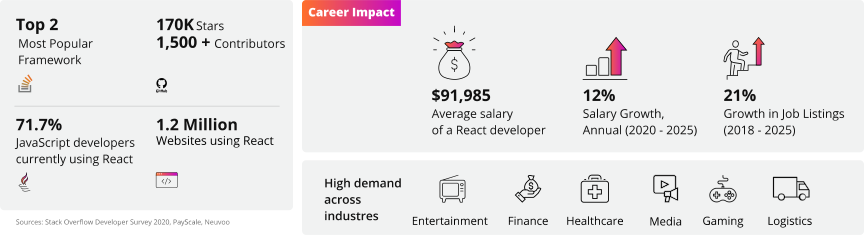
According to Stack Overflow, JavaScript’s React is the library that most developers want to work with (>71 percent). React is powering the mobile revolution and is a critical skill that developers need to innovate and reach more users on mobile platforms. To date, this JavaScript library fuels 46 percent of all the world’s websites and applications.
..... Read moreTo gain in-demand skills in React, talk to our Learning Advisor today.
Immersive Learning
Learn by Doing
Cloud Labs
Outcome-Focused
Blended Learning
Gain insights into components, building blocks of a React app; build and compose reusable components.
Learn and embrace JSX, the syntax extension to JavaScript, for writing render logic quickly.
Learn how state helps you describe changes to your UI using data; build declarative data-driven apps using state.
Implement side effects such as network requests to a backend service or an API for fetching or storing data.
Implement Server Side Rendering (SSR) and build Isomorphic applications.
Master Redux including Redux Hooks, Redux Thunk and other middleware.
Embrace a test driven development (TDD) approach by using Jest, React Testing Library, Enzyme and more.
Build efficient forms using controlled and uncontrolled components.
Master the incredible Hooks API and learn about context, error boundaries, portals and more.
Master code sharing and reusability using Render Props, Higher Order Components and more.
Learn and implement routing using React Router, implement code splitting and the Suspense API.
Learning Objectives
Discover what React is and the problems it solves when designing UIs and web applications. Get your first hands-on experience with React. Discover the create-react-app utility that generates a React development toolchain for an incredible developer experience.
Hands-On
Learning Objectives
Gain an insight into components, the building blocks of a React application. Learn about the two main types of components that you can build with React including a conceptual look at state and event listeners. Discover JSX, an HTML like syntax that allows you to express your UI within a React component.
Hands-On
Learning Objectives
Hands-On
Learning Objectives
Learn to render lists of components using the map() method. Understand the importance of the 'key' attribute. Learn to use the fragments feature for rendering multiple top level components
Hands-On
Learning Objectives
Hands-On
Learning Objectives
Learn to build form elements that are controlled by React. Learn to fetch form data directly from the DOM. Implement debouncing and other techniques to efficiently handle multiple form elements.
Hands-On
Learning Objectives
Implement shared logic using render props. Learn to reuse component logic using the HOC pattern.
Hands-On
Learning Objectives
Learn to render children in a DOM node that is outside of the parent's DOM hierarchy. Understand how event bubbling works with Portals.
Hands-On
Learning Objectives
Understand the nuances of data flow in a React application, and the issues with sharing global data using props in a deeply nested application. Learn and understand all about the Context API that lets you share global data without using props.
Hands-On
Learning Objectives
Get an introduction to the Hooks API and the motivation behind them. Learn to incorporate stateful properties in a function component using the useState() hook. Learn to ingest data from a Context provider using hooks and to implement the useReducer() hook. Finally, learn to write your own hook.
Hands-On
Learning Objectives
Understand Routing in a React application, and learn about Dynamic Routing and Setup React Routers. Implement nested routing and use query parameters. Learn to protect routes from unauthenticated access.
Hands-On
Learning Objectives
Learn to optimize your production bundle by implementing code splitting using dynamic imports and the Suspense API. Learn to implement code splitting, lazy loading and suspense when working with React Router.
Hands-On
Learning Objectives
Understand the need for server-side rendered apps. Learn to setup a Node.js (Express) server for rendering React apps on the server. Build a toolchain using Webpack and Babel to compile React code on the server and for the client.
Learning Objectives
Understand the need for a dedicated state management solution and discover Redux. Take your first steps with Redux as you install, setup and connect it to a React application. Learn to build action creators and add mutation logic in the reducer for the Catalog component.
Next, you will learn to use the connect() higher order function to interface React components with the store. You will be able to build action creators and complex state mutation logic for the Cart component. Learn to use Redux hooks and implement optimizations for performance. Also learn to implement middleware, async action creators and data persistence.
Learning Objectives
Understand the role of testing in application development. Learn to use Jest with test-utils from the React-DOM library for writing unit and integration tests. Next, learn to write tests using Jest and the React Testing Library. Finally, learn about React Testing Library, a framework for testing React Components.
The Web Development Using React certification course has been thoughtfully designed to make you a skilled React developer ready to take on significant front-end roles in top tech companies. At the end of the course, you will be able to:
The program takes you on a learning journey from the absolute basics and concepts of React, all the way up to building comprehensive web applications that include client side routing using React Router, global state management and transitions using Redux with test driven development using Jest, Enzyme and more.
Moving away from archaic workflows, practices, and techniques in favour of a modern workflow that is in line with the development roadmap of React, this course has been designed with a modern and future safe approach to React.
Whatever your level of expertise – beginner, intermediate or expert – this training will give you the work-ready skills you need to become a confident developer.
Yes, our Web Development Using React certification course is designed to give you the flexibility to skill up at your convenience. We have both weekday and weekend batches to accommodate your current job and have interesting projects that will keep you practicing as you learn. The course is delivered both in a Blended Learning and Self-Paced mode so that you can balance your work and learning as per your schedule.
In addition to training hours, we recommend spending about 2 hours per day every day of the training, to study, practice and achieve optimal benefits from the course.
The Web Development Using React training courses are well suited for UI Developers, Full Stack Developers, Solution Architects, developers, software engineers, and anyone interested to develop interactive user interfaces and web applications using React. Novices too will benefit from this training, provided prerequisites are met.
To attend the React JS certification training program, the basic hardware and software requirements are as mentioned below -
Hardware requirements
Software Requirements
System Requirements
HTML and CSS skills would be required for developing ReactJS applications. Although React uses JSX, HTML fundamentals are necessary and CSS skills are useful to style React applications.
Yes! Upon passing the Web Development Using React JS Certification Course, you will receive a signed certificate of completion from KnowledgeHut. Thousands of KnowledgeHut alumni use their course certificates to demonstrate skills to employers and their networks.
More than the certificate, however, you will get to showcase your newly acquired React skills by working on real-world projects and adding these to your portfolio. KnowledgeHut’s is well-regarded by industry experts, who contribute to our React JS syllabus and use our tech programs to train their own teams to provide the best React course in the market.
One of the key features of our course is the opportunity to work on fun micro-projects during the program followed by a production grade capstone project at the end. This course is full of fun examples throughout the course of instruction, followed by even more exercises that you get to work with on our web-based interactive development environment.
At key milestones during the course, you get to work with micro-projects. Some of the projects you will work on are:
Solidify your grip on React and its ecosystem of tools/products such as Redux and React Router with a capstone project at the end of the course. You will create a full-blown micro blogging application using React, Redux and React Router. You will be provided with a stylesheet, an API server and will be required to build an app that allows users to signup, sign in, add short message posts, delete them, sort them and more.
Once you have mastered the React JS online course, you can consider learning the following:
Individuals can try out KnowledgeHut’s immersive learning experience using a free trial. You have 14 days or 30% access, whichever comes first, to the course you’ve started the free trial for. This includes all the features of the platform, including on-demand videos, 3 hours of Cloud Labs, auto-graded assessments, interactive eBooks, recall quizzes and advanced learning insights.
The Web Development Using React workshop at KnowledgeHut is delivered through PRISM, our immersive learning experience platform, via two modes of delivery:
Blended learning
On-Demand Self-Learning
The Web Development Using React course is delivered by leading practitioners who bring current best practices and case studies from their experience to the training sessions. The instructors are industry-recognized experts with more than 10 years of experience in React and web development.
Not only will they impart knowledge of the fundamentals and advanced concepts, but they will also provide end-to-end mentorship and hands-on guidance on the real-world projects.
Our workshops are structured in three parts – pre-workshop, workshop and post-workshop – to provide you with a completely immersive learning experience. This tried and tested workshop structure has worked well with thousands of engineers we’ve helped upskill over the years.
A unique feature of our Web Development Using React course is the highly engaging, immersive learning you experience. You get to learn, practice, assess, get insights on your learning, and personalize your learning journey.
LEARN: Engaging self-learning videos, smart flashcards, interactive eBooks and recall quizzes help reinforce your learning. You also get to maximize your learning potential with collaborative social learning via discussion forums and group and one-to-one messaging.
PRACTICE: Access our Playground Labs during and after the course. Guided hands-on exercises will help you gain confidence and get productive from day one.
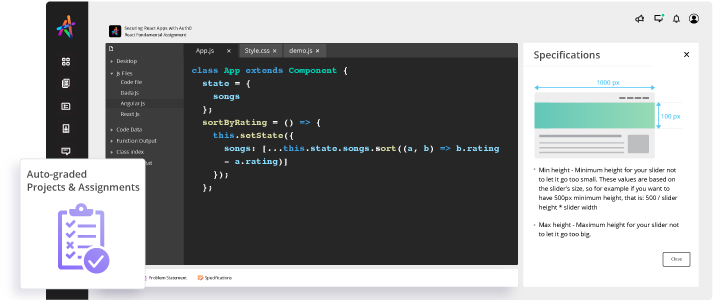
ASSESS: Assess your skills at every stage with a variety of questions ranging from multiple choice to code-based, completely auto-graded by the system. Assignments and projects within our inbuilt and intelligent development environment give you micro “work-like” experiences. Test your subject matter comprehension through diagnostic, module level and final assessments.
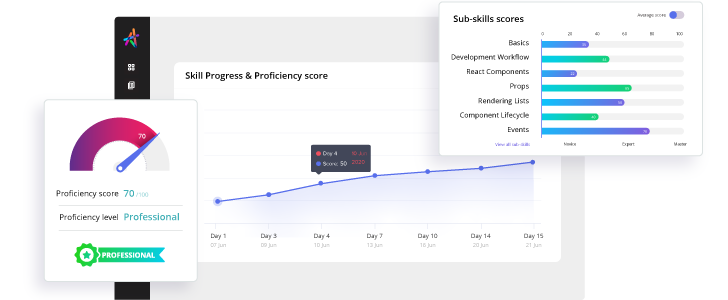
GET INSIGHTS: Based on your performance in the assessments, assignments, and projects, you gain deep insights on your progress, which help you identify areas you are good at and where you need to improve. All you need to do is follow recommendations and enhance your skill proficiency from where you are to where you want to get.
PRISM is KnowledgeHut’s state-of-the-art learning experience platform. PRISM is designed to provide a highly engaging, immersive learning experience with you at the center of the learning.
PRISM supports all types of courses, including on-demand self-paced learning, blended learning, and virtual classes. Here are some key features of the platform:
Our Web Development Using React workshops are currently held online and anyone with a stable internet from anywhere across the world can benefit from this to skill up in React.
Schedules for our upcoming React JS course online workshops in Web Development Using React can be found here.
You will receive a registration link from PRISM to your e-mail id. You will have to set your password, log in to our Immersive Learning Experience platform and start your learning journey.
Yes, Cloud/Practice Labs in a preconfigured development editor inbuilt into your learning space will be available for your guided hands-on exercises, assignments and practice during and post the training.
The playground labs are low-friction sandbox environments, offering the ability to get started without any installations in your local system. We have tried hard to ensure that practice labs simulate the developer experience. These in-browser solutions feature environments for working with all kinds of platforms including operating systems, coding languages, and more.
The goal is to provide you with sandbox environments where you can feel free to run any command and experiment without the guidelines of a typical lab. The end goal is to increase the amount of practical, real-world experience you gain to get you completely work-ready on course completion.
You will be granted 100 hours of access to Cloud Labs to perform all your hands-on exercises, assignments, and projects including your final capstone projects. Post the training, you will retain access to the platform, the learning material, and any unutilized hours on the Cloud Labs for a period of six months.
Practice is key to taking your coding skills to the next level. Should you need additional hours of practice on Cloud Labs, these will be available for purchase. Just raise a ticket on PRISM or write to us at support@knowledgehut.com and we'll set this up for you.
You will have lifetime access to the entire Self-Paced Learning material including on-demand videos, assessments, quizzes, ebooks/case studies and more.
You can attempt the recall quizzes any number of times. Assessments can be taken twice.
We currently use the Zoom platform for video conferencing and will soon be adding more integrations like Webex and Microsoft Teams. However, all the sessions and the recordings will be available right from within our learning platform. Learners will receive instructions through PRISM notifications and will not need to wait for any external notifications or links.
Yes, there are other participants who actively participate in the class remotely. They can attend online training from office, home, or any other suitable place.
In case of any queries, our support team is available to you 24/7 via the Help and Support section on PRISM. You can also reach out to your workshop manager on your workshop group messenger.
If you miss a class, you can access the class recordings from PRISM at any time. At the beginning of every session, there will also be a 10-12 minute recapitulation of the previous class.
Should you have any more questions, please raise a ticket on
PRISM or email us on support@knowledgehut.com
and we will be happy to get back to you.
Streaming sessions are pre-recorded lectures crafted by top global instructors. These sessions focus on delivering theoretical knowledge with high-quality content, ensuring clarity and engagement for an effective learning experience.
Streaming sessions offer several benefits, including flexibility to learn at your own pace, the ability to revisit complex concepts, and consistent quality in content delivery. They are meticulously crafted and quality-checked to ensure an optimal learning experience.
Yes, interaction with instructors is a key component. In doubt resolving and master sessions, you'll engage directly with instructors and peers, fostering a collaborative and interactive learning environment.
React is a declarative, efficient, and flexible JavaScript library used in web development for building interactive UIs and web applications. It lets you compose complex UIs from small and isolated pieces of code called “components”.
A developer team at Facebook, led by Jordan Walke, developed React JS as a prototype in 2011. It was officially released by Facebook on May 29, 2013.
React JS was developed as a solution to the issues that engineers at Facebook were facing with code maintenance. The growing number of team-members and app-features had slowed them down as a company and over time, their app had become difficult to handle. They realized that they had the model right but needed to do something about the user experience, thus marking the birth of React.js.
Yes, the current iteration of Facebook is built using React, while the mobile app is built using React Native – a version of React specifically designed to display the iOS/Android native components.
React JS was officially released by Facebook on May 29, 2013.
React JS is not a programming language. It is a JavaScript library that has a unique approach to building user interfaces by breaking them into components. Combining an understanding of markup and content into JavaScript, ReactJS renders dynamic views efficiently.
React JS is a library and is not strongly opinionated unlike a framework such as Angular. As a library, React can be incrementally brought into an existing website or application and allows ample flexibility without forcing you to learn special syntax that frameworks generally impose.
React JS is a frontend JavaScript library. It is used for client-side programming to build things that a user will see and interact with on screen. An experimental server side edition of React was recently demonstrated to solve performance issues arising from server side rendering of React applications for enabling better user experience and SEO.
React makes Document Object Model (DOM) faster by implementing a virtual DOM, structured like a tree, in JavaScript. So, every time React needs to read or write to the DOM, it will use the virtual version. The virtual DOM will then try to find the most efficient way to update the browser’s DOM.
Unlike browser DOM elements, React JS elements are plain objects that are cost-effective and easy to create. As JavaScript is very fast, the DOM tree in it speeds up React DOM to update the browser’s DOM and match the React elements.
No, React JS cannot be used for back-end. While it can make API calls (send requests to backend), which deals with the data, it cannot by itself deal with database or any data source. Hence, as of now React is only used by client side and not in the back-end.
The growing popularity of React JS can be attributed to its key features such as:
Here are the top reasons why React JS is so popular:
As one of the most popular JavaScript UI libraries with over 160K stars on GitHub and several million downloads every month, React is indeed the need of the hour and the future. Over 94,000 pages are estimated to use ReactJS, and more than 1300 developers are actively using ReactJS for development.
React’s benefits of being advanced, robust, non-risky, user-friendly, and responsible far exceed any disadvantages. Today, experts who hold a React JS certification are in high demand across several industries and new plugins are designed to meet the increasing additional functionality.
There is no difference between React and ReactJS. Such a distinction exists in certain programming languages, for instance, Angular - AngularJS referred to v1.0, which was totally different from v2 and above versions. The versions of Angular from v2 were eventually renamed to Angular.
However, in the case of React, there is no such distinction. Both React and ReactJS allude to the same library.
React is the core library that implements a medium agnostic framework for building components and managing their state and data flow. To make React work with web pages, we use the ReactDOM library along with the core React library. Similarly, React Native allows us to repurpose our knowledge of React for building native mobile applications for both iOS and Android.
React JS is being used by top organizations like Facebook, Instagram, Twitter, Netflix, WhatsApp, Dropbox, Tesla, BBC, PayPal, and Uber, to name a few.
With the help of React JS training, you can carry-out frontend development of web and mobile applications such as Dashboards, Messaging App, Social Networks, eCommerce Website, Enterprise Web Apps, Cross-platform Mobile Apps, Single Page Application, Blogging Website, and Productivity App, to name a few.
Key advantages of React over other JS Frameworks:
The following UI component libraries are recommended to be used with React JS:
React JS is a frontend development tool used for building interactive user interfaces (UIs) for single-page applications as well as full blown JavaScript web applications.
We use React JS in project areas such as Messaging App, Dashboards, Cross-platform Mobile Apps, Social Networks, eCommerce Website, Single Page Application, Enterprise Web Apps, Blogging Website, and Productivity App, to name a few.
The React JS training is useful when:
Yes. React JS is easy to learn provided, you have a few other coding skills under your belt including knowledge of JavaScript programming language.
KnowledgeHut’s systematic and holistic approach assures you the best React JS course on the market.
For sure! React is the one of the most popular JavaScript UI libraries in the world with over 160K stars on GitHub and several millions of download every month. It lets you compose complex, user-friendly, and fast interfaces efficiently and is used by top global companies like Facebook, Twitter, Instagram, Netflix, Tesla and AirBnb. As an in-demand skill in web development, mastery of React will help you become a much sought-after developer.
To learn React, all you need is a basic knowledge of HTML5 and CSS3 along with intermediate working knowledge of JavaScript. You can then take up a hands-on course like KnowledgeHut’s immersive learning React program, which will take you on a learning journey from the absolute basics and concepts of React, all the way up to building comprehensive web applications that include client-side routing using React Router, global state management and transitions using Redux with test driven development using Jest, Enzyme and more.
Typically, it can take anywhere between one to six months to gain the required proficiency to build as well as deploy a production ready React application within a reasonable timeframe. However, a lot depends on your existing programming expertise, your knowledge of web development fundamentals and your React JS learning path, choice of training, and dedication to practice.
With the learn-by-doing approach, lot of guided hands-on practice, work-like experiences and guidance from experienced developers that you get when you enrol into KnowledgeHut’s React training, you can become a skilled React developer ready to take on a senior tech role in top companies in a relatively short time.
The best way to learn React JS is by covering the fundamentals first. Gain basic knowledge in the following:
After covering the web-development fundamentals listed above, attend accredited React training and upskill.
No, you cannot learn React without knowing JavaScript. React is a JavaScript library, hence JavaScript is a pre-requisite.
Following are the prerequisites to learn React:
Follow the below roadmap step-by-step and become an ReactJS expert:
While there’s no standard React certification in the market, you can opt for ReactJS training from a reputed and industry-recognized training provider.
On passing the React training course at KnowledgeHut, you’ll receive a signed certificate of completion. Several thousands of KnowledgeHut alumni use their course certificates to demonstrate skills to employers and their networks.
More than the certificate, however, you will get to showcase your newly acquired React skills by working on real-world projects and adding these to your portfolio. KnowledgeHut’s is well-regarded by industry experts, who contribute to our curriculum and use our tech programs to train their own teams to provide the best React course in the market.
Since there are no standard certified courses available in the market you can always opt for ReactJS training from KnowledgeHut and become a ReactJS professional.
A React developer is able to harness the power of React for build sophisticated and highly performant UI components and web applications. A React developer has strong JavaScript skills, deep knowledge of React with the ability to visualize a complicated UI or application in terms of discrete components, each playing their part towards a common goal.
You will need to equip yourself with the following to become a skilled React developer:
You will need to have a good grasp of:
Certainly! React is one of the most popular web development frameworks and React developers are in high demand across industries. React has over 160K stars on GitHub and several millions of download every month. Over 94,000 pages are estimated to use ReactJS, and over 1,300 developers are actively using ReactJS for development.
According to HackerRank’s 2020 Developer Skills Report, 32 percent of developers say React is the framework they are learning next.
Facebook and the entire ReactJS team is committed to enhancing ReactJS efficiency due to React’s increasing popularity as more and more companies adopt this versatile technology. New plugins are being designed for ReactJS to meet the increasing additional functionality.
React JS Developers can expect additional React features such as new render types, improved error handling, enhanced server-side rendering, and more.
Following are the leading roles offered to React JS developers:
According to HackerRank’s 2020 Developer Skills Report, React has the biggest skill gap, 33% of employers need React skills but only 19% of developers today have React expertise.
The average salary for a ReactJS developer is $92,023 in US and INR 7,35,000. The salary for a React JS developer varies with the designation. Average salaries for leading React JS developer roles are as follows:
| Average Salary Per Annum - US | Average Salary Per Annum - India | |
| Frontend Developer | $82,229 | INR 475,885 |
| Web Developers | $59,876 | INR 6,80,680 |
| Full-Stack Developers | $79,838 | INR 5,99,995 |
Source: PayScale
Top companies hiring React JS professionals are Instagram, Twitter, Netflix, WhatsApp, DropBox, BBC, GitHub, PayPal, Tesla, and Uber, to name a few.
Here are 4 popular ways to install React in the latest version of Windows/Mac/Linux:
The best way to setup a React application is by using the create-react-app utility:
Step 1: Install Node.js and verify installation
Step 2: From the terminal/command prompt execute npx create-react-app my-app where my-app is the name of your app
Step 3: Once installed, go into the folder created by the above utility and execute npm start
Directly visit the package.json file and see the React app version at dependencies: {} section
To remove a package from your node_modules directory, use the uninstall command. If the package is scoped, include the scope.
Step 1: Unscoped package: npm uninstall package_name
OR
Scoped package: npm uninstall @scope/package_name
Step 2: Remove a package from the dependencies in package.json, use the --save flag. If the package is scoped, include the scope.
Unscoped package: npm uninstall --save package_name
OR
Scoped package: npm uninstall --save @scope/package_name
To remove a package from your node_modules directory, use the uninstall command. If the package is scoped, include the scope.
Step 1: Unscoped package: npm uninstall package_name
OR
Scoped package: npm uninstall @scope/package_name
Step 2: Remove a package from the dependencies in package.json, use the --save flag. If the package is scoped, include the scope.
Unscoped package: npm uninstall --save package_name
OR
Scoped package: npm uninstall --save @scope/package_name
Redux is a popular JavaScript library used for managing the state of frontend applications. React Redux is the official React binding for Redux, it allows React components to read data from a Redux store and send commands to the store for data-updation.
Redux is a JavaScript library used for managing the state of frontend applications and exhibits flux like flow with a single store.
React Redux is used to bind React with Redux. It creates containers that listen to the store's state changes, prepares the props, and re-renders the presentational components.
The key benefits of using Redux are as follows:
Redux Saga is a redux middleware library designed to make handling of redux app side effects easy. It leverages an ES6 feature called Generators which allows us to write code that looks synchronous and is easier to test.
Flux is an application architecture that is used for building client-side web applications with React. It is useful when we work with dynamic data and need to effectively keep the data updated. It also reduces the runtime errors.
Flux is an application architecture that is used for building client-side web applications while Redux is a JavaScript library used for managing the state of frontend applications. Both Redux and Flux have distinct applications and comes with their own set of key features. As web developers, you will benefit from learning both Redux and Flux.
A boilerplate is a code template that can be cloned and reused for various project. React Boilerplate is a highly scalable, production-ready boilerplate that offers a virtual environment for developers to easily develop applications.
React DOM is a package that provides DOM specific methods and implements the Virtual DOM. It is used at the top level of a web app to efficiently manage DOM elements of the web page.
While React is a JavaScript library, designed for building interactive UIs, React-DOM is a library that binds React to the browser DOM.
React v16.0 has some major updates and changes to the core algorithm. Here is a brief introduction to the changes:
There are several benefits of getting trained on React. Here are the main benefits:
Here are some ways beginners can get started with React:
React is the one responsible for everything that is happening on the server-side. It mainly influences front-end development.
The main reason why React is faster is because of its virtual DOM that renders everything in JavaScript and changes the things that are changed in actual DOM. Another feature that makes React faster is the keys in Arrays through which React allows fast array changes in elements.
To choose the best React training institute, you need to look at their course structure. Also, be mindful of the hands-on assignments and supplements. Lastly, check the price. If it's out of your budget, move on to the next option.
Here are the top five companies using React: